
Many homeowners ask whether drywood termites can be treated without tenting. Sometimes they can. When the infestation is limited to wood we can find and reach, a localized treatment of that wood can be the right call. When termites are spread through the structure or hidden behind walls, tenting is still the way to treat the whole house. Cal Termite & Pest Control explains which applies to your home after a free inspection, in Ventura, Santa Barbara and Los Angeles counties.
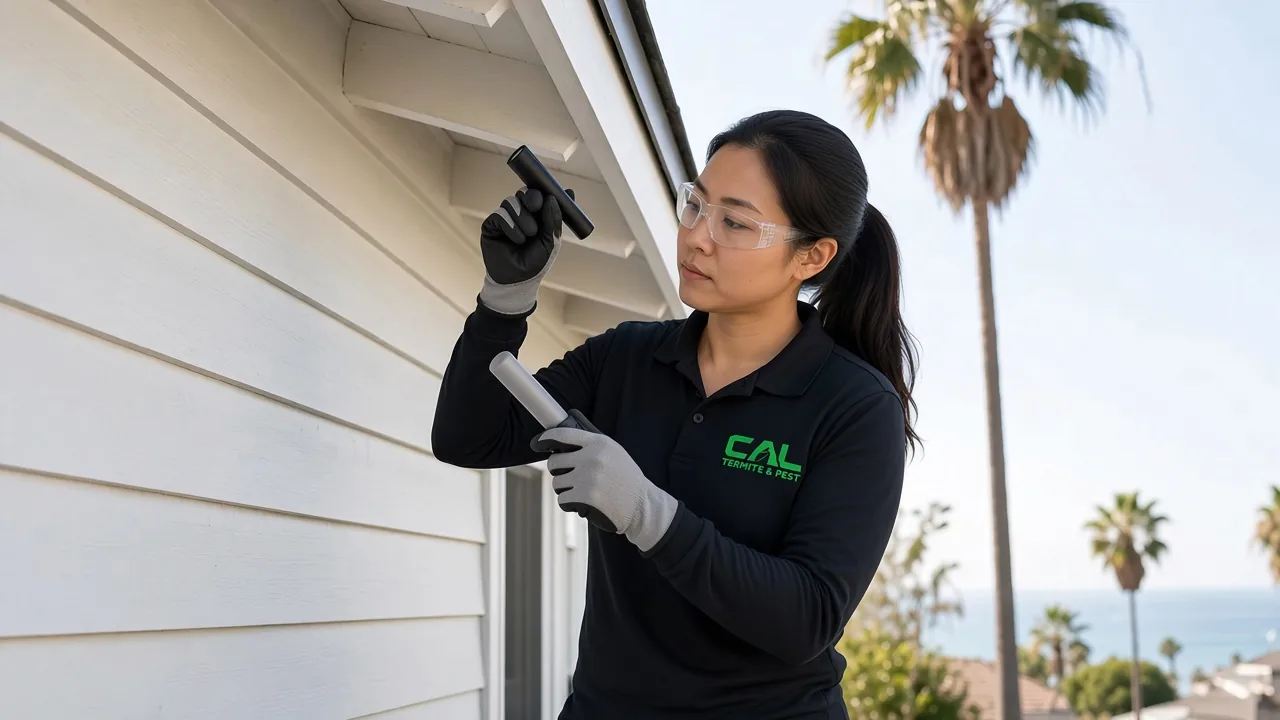
Localized Treatment Versus Tenting
According to UC IPM, drywood termite treatments fall into two groups:
- Whole-Structure Treatment (tenting, or fumigation) treats every piece of wood in the house at once, including infestations hidden inside walls, ceilings and attics that no one can see.
- Localized or Spot Treatment treats the infested wood directly. UC IPM notes it works well when the colony has been accurately found and the treatment reaches it, but it cannot be relied on to reach infestations hidden behind drywall, stucco or other coverings.
That is why the inspection decides the treatment. UC IPM points out that finding drywood termites accurately is difficult, and that the success of a localized treatment depends on how well the infestation has been found.
When No-Tent Treatment Can Work
- The termites are in a few boards or a limited area, such as a window frame, a door frame, a section of eave or a piece of trim.
- We can see and reach the infested wood from the attic, the crawl space, the outside of the house or an exposed area.
- The inspection does not show signs of other infestations spread through the house.
When Tenting Is Still the Right Answer
- Pellets, kick-out holes or damage show up in several rooms or several parts of the house.
- The infestation runs into wood we cannot reach, such as inside finished walls, ceilings or built-ins.
- You want the whole structure treated at once, for example before a sale or after earlier spot treatments have not held.
When a house needs tenting, we arrange it through our licensed fumigation partners and coordinate the inspection, the prep and the follow-up with you. See Termite Fumigation for how that works.
Subterranean Termites Are Different
Subterranean termites live in the soil and come up into the house through mud tubes. They are not treated by tenting at all. They are treated where they enter, at the soil and foundation. See Termite Control for how we treat them.
How It Works
- Free Inspection We inspect the accessible areas of the house, including the attic, crawl space, garage, eaves and the rooms where you have seen pellets or wings, and mark every area with termite activity or damage.
- A Clear Recommendation We tell you whether a localized treatment is likely to reach the infestation we found, or whether tenting makes more sense, and why. You get a written quote before any work starts.
- Treatment For a localized treatment, we drill into the infested wood and inject a product registered for drywood termites into the galleries, applied by the label. We will tell you what we use before we start. We will not recommend a spot treatment where we do not think it can reach the termites.
- Wood Repair Damaged boards can be replaced at the same time. See Termite Wood Repair.
- Follow-Up A local treatment carries a 1-year warranty on the areas we treated. If termites come back there during that year, we treat them at no charge, and Extended Care can keep coverage going after that.
At a Glance: No-Tent Treatment Versus Tenting
Both treat drywood termites. They differ in how much of the house they reach and what you have to do.
| Compare | No-tent (localized) treatment | Tenting (fumigation) |
|---|---|---|
| What it reaches | The infested wood we drill and inject | Every piece of wood in the house, including hidden infestations |
| Works best when | Termites are in a few boards we can see and reach | Termites are in several rooms or in wood we cannot reach |
| Hidden infestations | Cannot be relied on to reach colonies behind drywall, stucco or other coverings | Reached, because the whole structure is treated |
| Leaving the house | Usually not for long | Three days and two nights |
| Prep | Your technician tells you if any rooms are off limits | Food bagging, plants trimmed back 12 inches from the walls, pets off the property, gas shut-off and turn-on |
| Warranty | 1 year on the areas treated | 3 years |
Read Termite Fumigation for the step-by-step, or Termite Control to see where soil treatment fits for subterranean termites. The inspection decides which one your house needs.
Common Questions
Can Drywood Termites Be Treated Without Tenting?
Yes, when the infestation is limited and the infested wood can be found and reached. We drill and inject the infested wood directly. UC IPM notes that localized treatment works well when the colony is accurately found and treated. When termites are widespread or hidden in walls, tenting treats the whole structure.
Is a No-Tent Treatment as Thorough as Tenting?
It treats the wood we treat. UC IPM says localized treatments cannot be relied on to reach infestations hidden behind wall coverings, which is why we only recommend them when the inspection shows the infestation is limited and reachable.
Do I Have to Leave the House for a Localized Treatment?
Usually not for long. Unlike tenting, a localized treatment covers specific areas. Your technician will tell you if you need to stay out of any rooms and for how long.
Can I Treat Drywood Termites Myself?
UC IPM does not recommend it. Finding drywood termites is hard, and the products used for localized treatment are generally not sold to homeowners.
What Affects the Cost?
How much of the house is infested, how easy the wood is to reach, and whether any wood needs repair. You get a written price after the free inspection.
Why Homeowners Call Cal Termite for Termites
- Free inspection, followed by a written quote.
- Same-day service is available.
- A warranty on termite work: 3 years after tenting, 1 year after a local treatment, and 1 year on wood repairs.
- Registered with the California Structural Pest Control Board, PR 7556.
- Damaged wood repaired by our own crew.
- Local offices in Ventura, Woodland Hills and Santa Barbara.